Observational evidence
By nature, black holes do not themselves emit any electromagnetic radiation other than the hypothetical Hawking radiation, so astrophysicists searching for black holes must generally rely on indirect observations. For example, a black hole's existence can sometimes be inferred by observing its gravitational influence on its surroundings.
On 10 April 2019, an image was released of a black hole, which is seen magnified because the light paths near the event horizon are highly bent. The dark shadow in the middle results from light paths absorbed by the black hole. The image is in false color, as the detected light halo in this image is not in the visible spectrum, but radio waves.
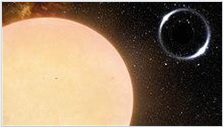
Artist's impression of the closest black hole to Earth and its Sun-like companion star
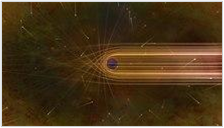
This artist's impression depicts the paths of photons in the vicinity of a black hole. The gravitational bending and capture of light by the event horizon is the cause of the shadow captured by the Event Horizon Telescope.
The Event Horizon Telescope (EHT) is an active program that directly observes the immediate environment of black holes' event horizons, such as the black hole at the centre of the Milky Way. In April 2017, EHT began observing the black hole at the centre of Messier 87. "In all, eight radio observatories on six mountains and four continents observed the galaxy in Virgo on and off for 10 days in April 2017" to provide the data yielding the image in April 2019. After two years of data processing, EHT released the first direct image of a black hole; specifically, the supermassive black hole that lies in the centre of the aforementioned galaxy. What is visible is not the black hole—which shows as black because of the loss of all light within this dark region. Instead, it is the gases at the edge of the event horizon (displayed as orange or red) that define the black hole.